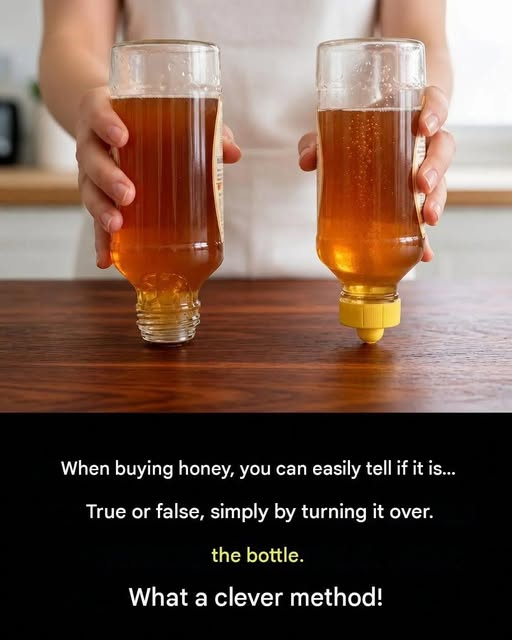
Viral posts frequently show glass or plastic squeeze bottles of honey turned upside down, accompanied by claims like “When buying honey, you can easily tell if it is… True or false, simply by turning it over… What a clever method!” These graphics exploit consumer anxiety over food purity to farm engagement, shares, and website traffic.
- The Clickbait Engagement Strategy: Content creators use visual puzzles, awkward phrase structures, and high-contrast “test” images to provoke curiosity. By promising that a simple 2-second trick like watching a bubble rise can instantly detect “fake” or adulterated honey in the grocery store aisle, these posts compel users to leave comments, save the video, and click through ad-laden sites.
- The Physics of Viscosity and Bubble Rise: Turning a honey bottle upside down simply demonstrates fluid viscosity, density, and temperature dynamics—not biological purity or authentic origin. The speed at which an air bubble moves upward through liquid is governed by Stokes’ Law, which depends heavily on ambient temperature, moisture content, and sugar concentration, rather than whether the honey was produced by bees or adulterated with corn syrup.
- The Composition of Honey: Genuine honey is a supersaturated sugar solution (primarily fructose and glucose) containing roughly 15% to 18% water. High-fructose corn syrup, rice syrup, and glucose syrups share extremely similar sugar ratios, densities, and rheological properties, making simple visual or gravity-based physical tests completely incapable of distinguishing pure honey from adulterated mixtures.
