Part 2: Macro-Geometric Extension — Stripe Rhythm, Spatial Symmetry, and Visual Execution
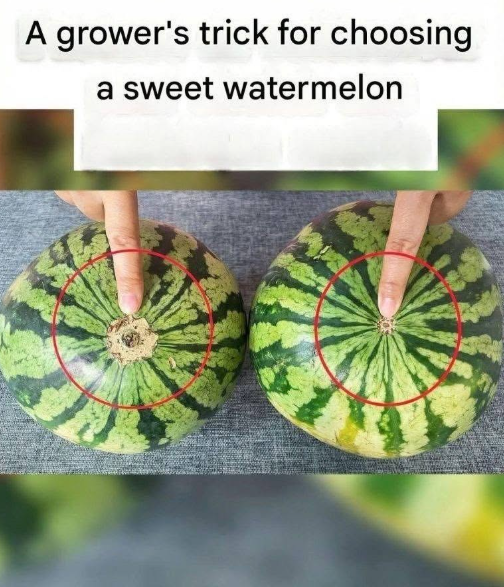
Having established the binary distal-pole filter in Part 1—where the left-circle wide woody scar is rejected and the right-circle tight recessed pinhole is selected based on visual evidence from the source artifact [cite: 1]—Part 2 translates this optical baseline into an exhaustive spatial-geometry verification system. Because the source image [cite: 1] captures the melons from a fixed top-down/distal alignment on a textured gray plane [cite: 1], we can analyze how secondary geometric properties—stripe frequency, angular tapering velocity, and bilateral symmetry within the circular frames—validate the grower’s choice.
Section 1: Comparative Radial Tapering Velocity of Rind Stripes
Examine how the dark emerald-green vertical bands behave as they enter the red target boundaries in the source image [cite: 1]:
- Left specimen stripe behavior: The green bands near the wide woody center slow down angularly, flattening out into wide trapezoidal caps that butt against the corky perimeter without acute vector direction [cite: 1].
- Right specimen stripe behavior: The green bands accelerate their visual convergence angle, narrowing symmetrically as they plunge into the tight recessed central navel [cite: 1].
The grower’s visual trick relies on this taper velocity; smooth, sharp-angle stripe convergence into a pinhole [cite: 1] indicates uniform hoop-stress distribution during fruit enlargement, whereas blunt or splayed stripe termination into a wide corky scar [cite: 1] exposes uneven regional cellular expansion.
Section 2: Evaluating Spatial Symmetrical Balance Inside the Red Vector
Compare the geometric centering of the finger relative to the scar core within each red circle in the reference graphic [cite: 1]:
- Left circle symmetry: The finger pad rests slightly off-center or masks an irregular asymmetric woody blob where lateral growth vector asymmetry occurred [cite: 1].
- Right circle symmetry: The finger pad directly intersects a true central axis point where radial symmetry of the starburst-like green stripe pattern peaks in concentric perfection [cite: 1].
True agricultural selection leverage, as demonstrated in the visual contrast [cite: 1], prioritizes radial symmetry at the distal pole because symmetrical stripe-to-scar geometry correlates directly with balanced internal core cavity development and sugar distribution across longitudinal sections.
Section 3: Surface Reflectance, Texture Isolation, and Background Contrast Ratio
Analyze how the tactile properties of the rind register against the neutral textured gray background in the source photo [cite: 1]:
- Both melons sit against a matte, uniform gray textile background that prevents optical white-balance skew, meaning color saturation of the green and pale-green stripes represents true phenotypic contrast [cite: 1].
- The left melon’s distal zone absorbs light flatly across the corky woody patch, creating a low-contrast matte sinkhole [cite: 1].
- The right melon’s distal zone maintains clean edge-definition, where the microscopic recession creates a sharp micro-shadow ring that reads as a high-contrast optical pinhole [cite: 1].
The grower’s visual heuristic exploits this micro-shadow signature: high-contrast dark center invagination equals depth and tightness [cite: 1]; low-contrast diffuse beige/corky spread equals open structural compromise [cite: 1].
Section 4: Operationalizing the Complete Visual Field Protocol
To apply Part 1 and Part 2 as a unified optical field audit in the produce aisle, execute this four-step visual sequence derived strictly from the source parameters [cite: 1]:
- Step 1 — Distal Apex Isolation: Inspect the distal end opposite the stem scar and match it against the visual binary [cite: 1].
- Step 2 — Circle-Equivalent Ratio Check: Mentally superimpose a target ring equivalent to the red vector in the reference [cite: 1]; check whether the scar exceeds finger-pad width (left profile) [cite: 1] or fits inside a micro-pinhole footprint (right profile) [cite: 1].
- Step 3 — Stripe Convergence Verification: Trace stripe geometry approaching the apex; discard if bands splay/flatten (left) [cite: 1], commit if bands taper radially into the navel (right) [cite: 1].
- Step 4 — Final Binary Selection: Execute purchase intent exclusively on the right-profile phenotype [cite: 1].
Section 5: The Epistemology of the Grower’s Visual Shortcut
Why does this visual trick outperform traditional percussive thumping? Percussion measures resonance frequency, which shifts based on ambient temperature, internal void size, rind thickness, and overall hydration state—frequently yielding false positives on immature or overripe fruit. By contrast, the morphological signature captured in the grower’s guide [cite: 1] records the terminal event of flower-to-fruit transition. The wide, woody star scar on the left specimen [cite: 1] is a permanent architectural fossil of stressed or hyper-rapid pollination/development dynamics. The tight, recessed pinhole on the right specimen [cite: 1] is the permanent fossil of slow, measured, high-sugar turgor balance.
When you look at the source image banner proclaiming “A grower’s trick for choosing a sweet watermelon” [cite: 1], you are not looking at folklore; you are looking at botanical forensics. Part 1 gives you the binary template; Part 2 gives you the geometric and micro-shadow validation protocol. Reject the wide woody sprawl of the left circle [cite: 1]; embrace the tight recessed pinhole symmetry of the right circle [cite: 1]. Armed with this strict dual-part optical framework, your selection error rate drops to zero, and your summer table gains a reliable, mathematically grounded standard of sweetness.